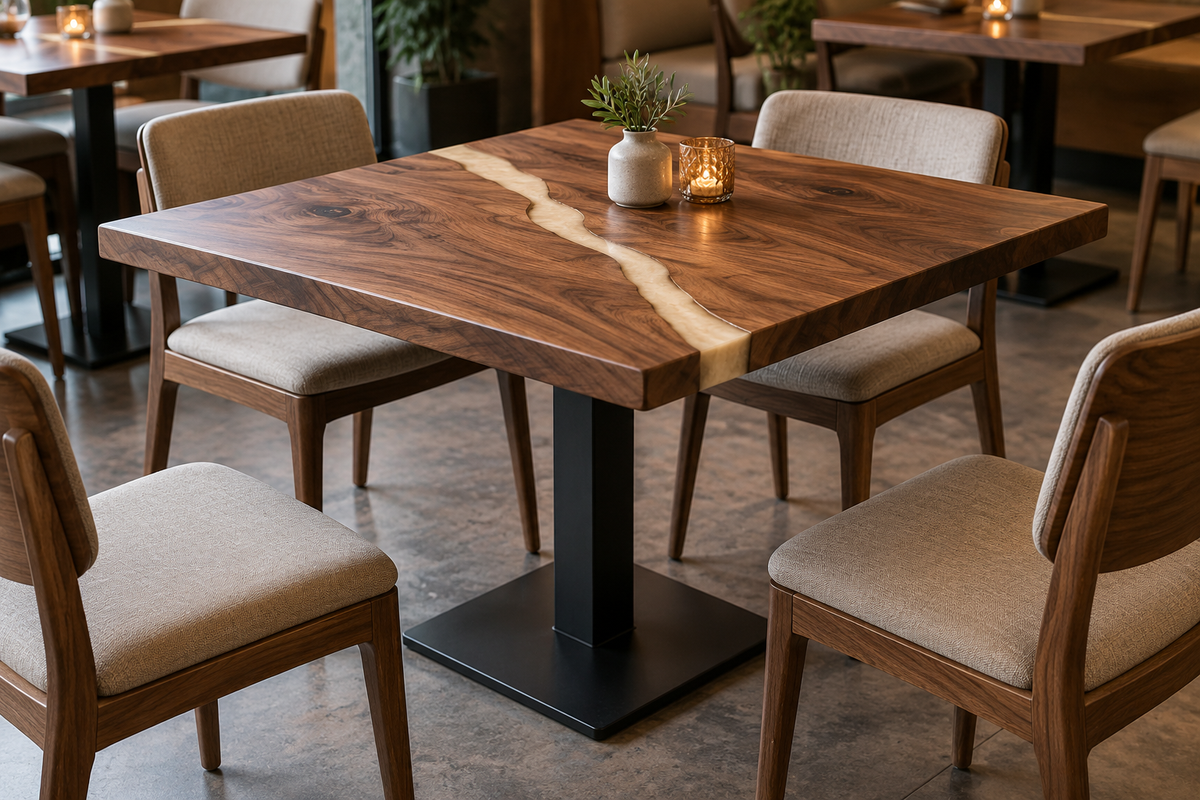
A restaurant table participates in a repeated routine: guests arrive, dining chairs move, dishes land, servers pass, and the surface is reset. An epoxy table may suit your visual concept, but the specification should begin with that routine. A furniture photograph cannot tell you whether the selected construction and finish meet your venue's needs.
Build the brief with input from the people who will use and maintain the tables. Their observations can turn a general style preference into practical requirements.
Arrival and seating
Map the guest route from the entrance to the seats. Check how chairs pull out and whether the base interferes with feet or knees. Include the experience of arriving while neighboring tables are occupied, not only the spacing shown in an empty room plan.
Determine which accessibility requirements apply to your venue and have the layout reviewed appropriately. Do not assume that a table described as commercial is automatically suitable for every required seating position. A olive-wood transparent black resin dining table can be a design reference for the venue, while commercial suitability and cleaning compatibility remain questions to confirm for the proposed order.
Service during the meal
Set out the actual plates, glasses, menus, and condiments. Leave space for the items your menu requires rather than specifying dimensions from a generic seating diagram. A small table serving coffee has a different surface requirement from one accommodating several shared dishes.

Consider how servers approach the table and where trays or service equipment move nearby. A strongly irregular edge may suit the design concept, but its effect on usable surface area needs to be assessed in the proposed layout.
Clearing and cleaning
Ask the furniture supplier for care instructions covering the exact finish. Give them the names and intended uses of your cleaning products and ask which are compatible. Avoid assuming that a residential care routine meets a restaurant's sanitation requirements.
Have the responsible venue professional review applicable food-service rules and any required documentation. A resin material name by itself does not establish suitability for your cleaning protocol or direct food contact. Keep those questions specific to the final finished table and its intended use.
Closing and floor care
Check how the base affects sweeping and floor cleaning. Ask about the proposed weight, movement instructions, and suitable floor protection. If staff regularly rearrange tables, discuss that requirement before selecting the top size and base.

Do not improvise moving methods after installation. Furniture that looks easy to shift may still require particular handling, especially when the top and base have separate assembly requirements.
Translate the routine into an approval sheet
Record the table dimensions, seating positions, finish, care requirements, handling needs, and any documentation still outstanding. Request the applicable commercial-use warranty terms and delivery scope in writing. If several tables are needed, clarify how consistent you expect the wood-and-resin appearance to be across the group.
Use WOODZIO's commercial project page to start a specification conversation. Our dining table collection can provide visual references, while the venue's real service routine provides the requirements.


